
What must be preserved? An audit of eight theories of consciousness from the engineering side

TL;DR
Consciousness preservation is an engineering problem with a philosophical dependency that nobody specs out. Whole-brain emulation roadmaps, brain-computer interface targets, and cryonics protocols all proceed as if it were settled what must be preserved. It is not. The eight major theories of consciousness with empirically testable predictions disagree on the engineering requirements by ten orders of magnitude.
The numbers, in one paragraph. Under Attention Schema Theory: ~1–10 TB, ~10^15 FLOPS, ~1 µm scanning resolution, comparable in scale to training a large AI model. Under Global Neuronal Workspace Theory: ~2 PB, ~10^18–10^22 FLOPS, ~10 nm. Under Integrated Information Theory: ~100 EB and the verification step is formally uncomputable on any classical hardware, regardless of progress. Under Orchestrated Objective Reduction: capturing the relevant state requires reading ~8.6 × 10^18 entangled tubulin qubits, which the no-cloning theorem prohibits. The gap is not a factor of two. It’s the difference between “buildable in a lab around 2050” and “violates known physics”.
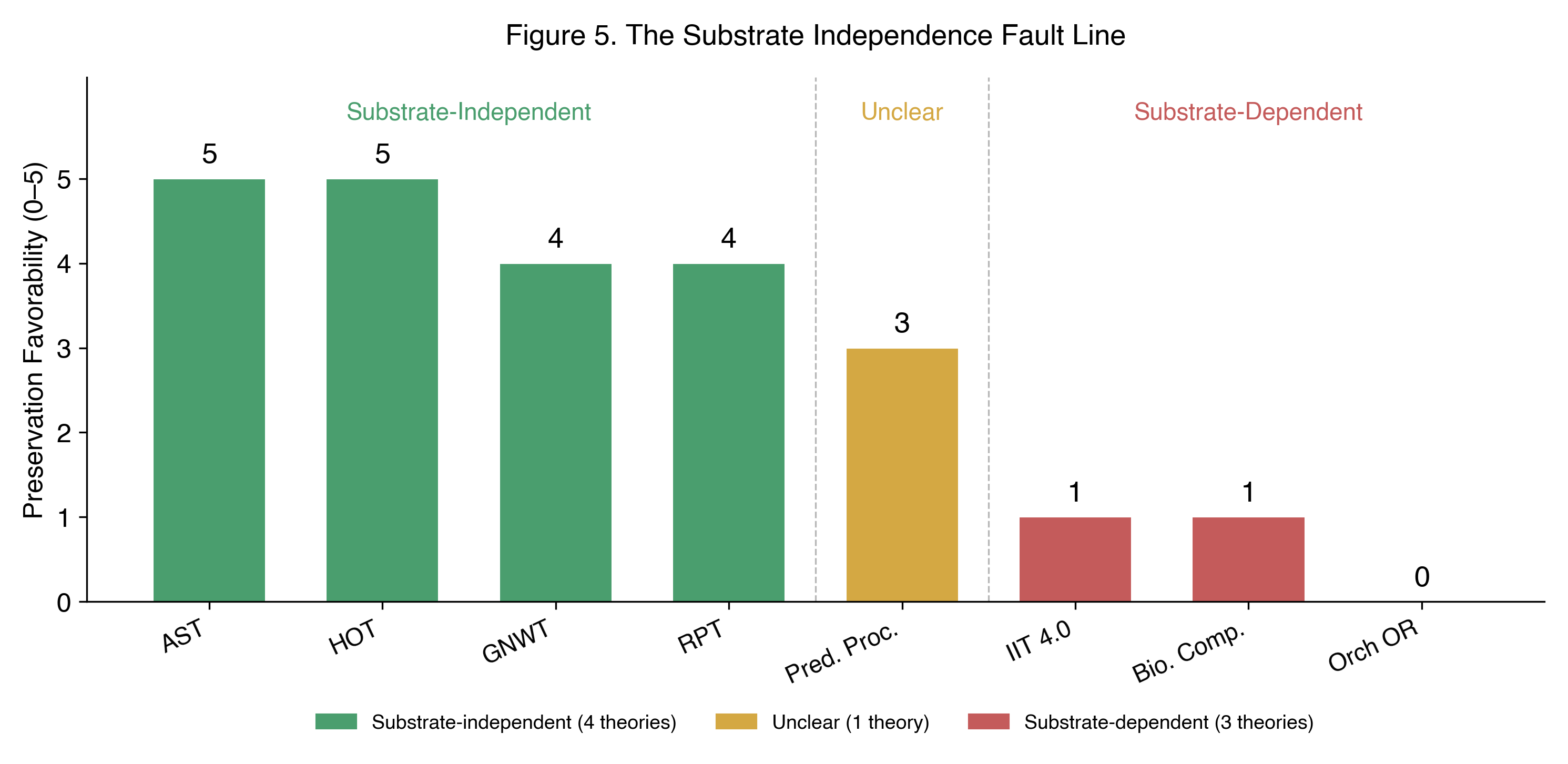
The 4-3-1 split on substrate independence is the load-bearing disagreement. Four theories say a digital copy is conscious; three say it isn’t; one is ambiguous. Nothing else in the engineering plan matters until that question resolves. Three convergent constraints drop out of the analysis regardless of which theory wins: temporal dynamics must be preserved, integration across components is required, and feedforward-only architectures are ruled out under every theory. A static connectome snapshot is insufficient under all eight.
And there is a paradox at the center of this whole enterprise. The theories kindest to preservation are the ones that deflate consciousness to a functional property or internal model. The theories that take phenomenal experience most seriously are the ones that make preservation hardest or impossible. You can’t have it both ways under any current theory.
The full preprint is on Zenodo: 10.5281/zenodo.19374628. This is the prose version of why I wrote it.
Why I wrote this
I came to this from systems security. The way I read code is to look for the unstated assumption that everything else depends on, the spec that was never written down because someone decided it was “obvious.” That’s what I kept noticing when I started reading the consciousness preservation literature: Sandberg and Bostrom’s whole-brain emulation roadmap, the cryonics protocol papers, Neuralink’s bandwidth roadmap. They are precise on the engineering side and silent on the upstream question that determines what the engineering target actually is.
Sandberg and Bostrom (2008) lay out fidelity levels for whole-brain emulation from spiking-level (10^18 FLOPS) to metabolome-level (10^25 FLOPS) and present them as options. They are essentially neutral on which level consciousness actually requires. Butlin et al. (2023) systematically map theories to indicators for detecting consciousness in artificial systems but address the inverse question from the one that matters for preservation. Chalmers (2010) argues philosophically for the possibility of mind uploading from a functionalist frame, which assumes the answer rather than deriving it.
That left a gap I wanted to read and couldn’t find. So I wrote it: derive engineering requirements from each major theory’s stated postulates, line them up side by side, and see what the implied engineering plan looks like under each. Eight theories, nine criteria, one engineering bridge table. The audit-by-spec frame is what I know how to do. The neuroscience I had to learn by reading.
I am not a neuroscientist or a philosopher of mind. I’d lose a debate with Anil Seth, Hakwan Lau, or Giulio Tononi in three messages. What I do bring is the discipline of treating “what must be preserved” as a spec question and reading the literature for where the spec is underspecified.
The eight theories, in one table
| Theory | Substrate independent? | What you’d need to preserve | Data | Compute (FLOPS) | Verdict (0–5) |
|---|---|---|---|---|---|
| Integrated Information Theory (IIT 4.0) | No. Intrinsic causal architecture matters, not function | Full transition probability matrix of every mechanism | ~100 EB | 10^22 (sim); 2^(2^N) verification (uncomputable) | 1 |
| Global Neuronal Workspace (GNWT) | Yes | Connectome + weights + ignition dynamics | ~2 PB | 10^18–10^22 | 4 |
| Higher-Order Thought (HOT) | Yes | Connectome of PFC + sensory targets, with weights | ~200 TB – 1 PB | 10^17–10^20 | 5 |
| Predictive Processing / FEP | Unclear. May need genuine embodied active inference | Generative model + precision weights + body model | ~5 PB | 10^18–10^21 | 3 |
| Recurrent Processing Theory (RPT) | Leaning yes | Recurrent connectivity + sub-ms feedback timing | ~2 PB | 10^18–10^20 | 4 |
| Biological Computationalism | No. Algorithm inseparable from biological substrate | Molecular-level snapshot of neurons, glia, ion channels, metabolome | ~10–100 PB | 10^25 | 1 |
| Orchestrated Objective Reduction (Orch OR) | No. Quantum coherence in microtubules required | Quantum state of ~10^18 tubulins | N/A (no-cloning) | 2^(10^18) | 0 |
| Attention Schema Theory (AST) | Yes | Attention schema + self-model + episodic memory | ~1–10 TB | 10^15–10^18 | 5 |
The data column spans roughly ten orders of magnitude. The compute column has an even wider spread, because Orch OR’s requirement (2^10^18 operations) is not a large number. It’s a quantity that cannot be meaningfully written down or compared to any physical thing. Feasibility timelines cluster into three groups: 2040–2060 under the most permissive theory, 2055–2080 under the moderate theories, and never under IIT verification or Orch OR.
The same data is easier to read as a layered pyramid: each layer is a level of biological detail, theories are pinned at the level they require, and the data volume label on the left rises by orders of magnitude as you climb.
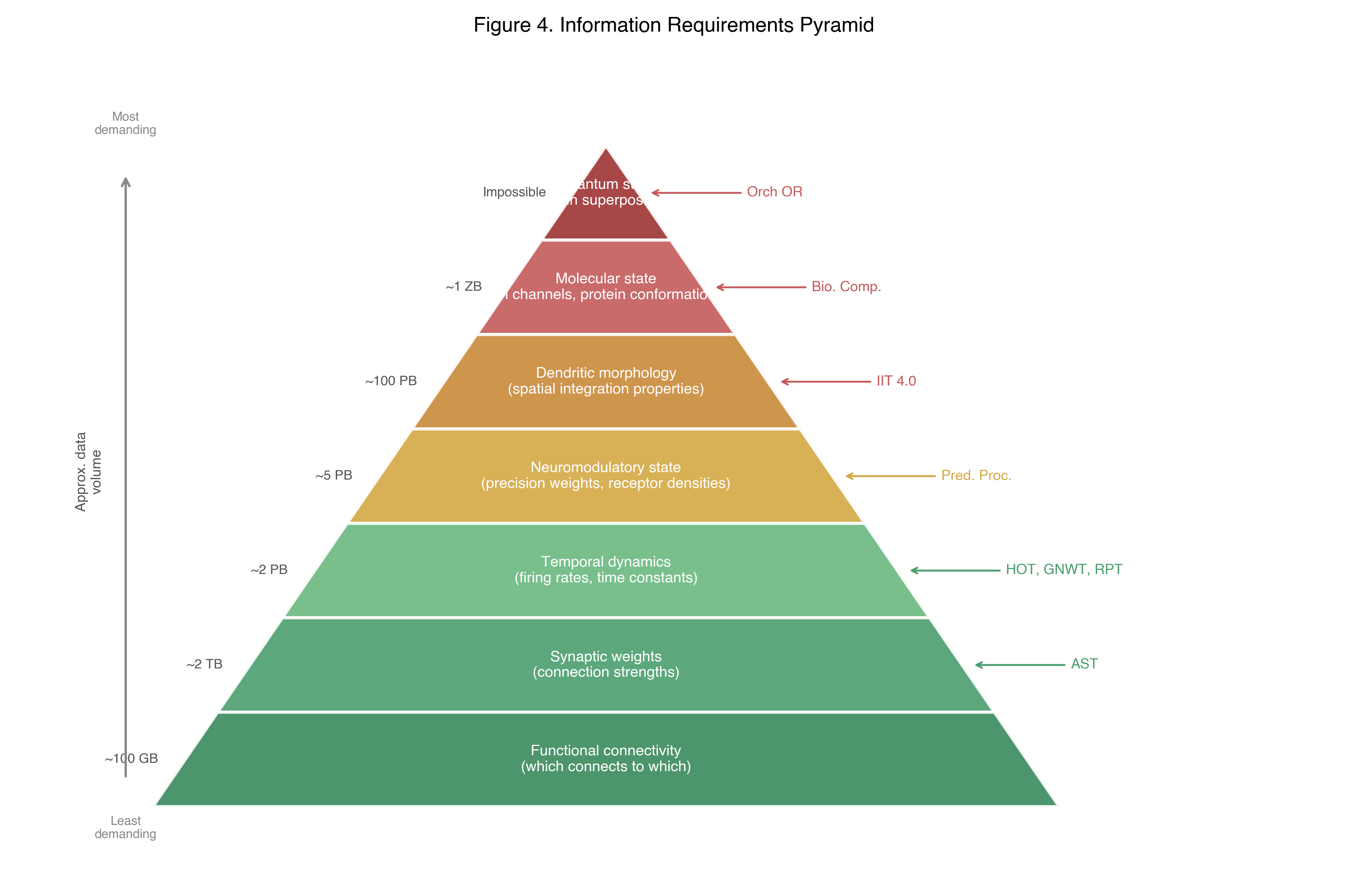
I want to be clear that I’m not saying the most permissive theory is the right one. I’m saying: until the theory question is resolved, nobody investing in preservation engineering knows what specification they’re optimizing against.
The fault line: substrate independence
The single most consequential disagreement is whether consciousness can run on a non-biological substrate. Four theories say yes. Three say no, for three different reasons: IIT because the causal architecture of the substrate determines Φ and a digital simulator’s CPU has the wrong architecture; Biological Computationalism because the brain’s computation is hybrid, scale-inseparable, and metabolically grounded in a way digital systems aren’t; Orch OR because the relevant computation is quantum-coherent in specific biological structures. One theory (Predictive Processing) hedges depending on whether genuine embodied active inference is required or just the right computational dynamics.
Whether digital preservation is even conceivable depends entirely on which side of this line is correct.
The cleanest experimental program to resolve it would be a neural prosthesis test in animals: replace a small cortical population with silicon neurons that are functionally identical to the originals, then check whether consciousness-relevant behavioral signatures (binocular rivalry, no-report paradigms) are preserved. Current neural prostheses (retinal implants, cochlear implants) restore function but don’t replace individual neurons at the fidelity required to discriminate the theories. The COGITATE adversarial collaboration (2025) was a first move on the IIT-vs-GNWT comparison; we need more of those, designed specifically to attack the substrate-independence question.
Where all eight theories agree
Despite the headline disagreements, three constraints drop out of the analysis regardless of which theory wins.
Temporal dynamics must be preserved. No theory treats consciousness as a static property of a network. IIT requires a specific causal grain at which Φ is maximized. GNWT requires ignition events with specific temporal profiles. RPT depends on feedback signals arriving inside narrow windows (~100–300 ms post-stimulus). Predictive Processing requires ongoing prediction-error minimization at hierarchical timescales. AST requires dynamic schema updating. A connectome snapshot without dynamics is insufficient under all of them.
Integration across components is required. Every theory requires that information be combined across processing streams rather than remaining isolated. That’s literally what IIT defines consciousness as, but GNWT requires global broadcast across modules, HOT requires monitoring across representational levels, RPT requires recurrent interactions across cortical layers, PP requires hierarchical coordination of predictions, AST requires the schema to integrate information about the attention mechanism. This rules out any preservation strategy that captures neurons or circuits in isolation.
Feedforward-only architectures are out. Every theory requires recurrence or feedback. IIT assigns Φ = 0 to feedforward networks. GNWT requires re-entrant broadcast. HOT requires bidirectional monitoring. RPT defines consciousness as recurrent processing. PP requires top-down predictions meeting bottom-up errors. AST requires feedback from the schema to the attention mechanism. The empirical literature backs this up: the initial ~100 ms feedforward sweep through visual cortex does not produce conscious experience.
These are tiny consensus items compared to the ten-orders-of-magnitude disagreement on data volume, but they’re something. Anyone designing preservation hardware can lock in those three constraints today and know they’re robust across the theory space.
The deflation paradox
This is the part of the analysis I had not seen anyone state plainly, and which made the paper feel worth writing.
The theories that are kindest to preservation (AST and HOT) are precisely the ones that deflate consciousness to a functional or representational property. Under AST, consciousness is “just” the brain’s simplified internal model of its own attention. Under HOT, consciousness is “just” the brain’s higher-order monitoring of its own first-order states. These theories make preservation easy because they reduce the target to an information-processing pattern, which is substrate-independent and information-theoretically compact.
The theories that take phenomenal consciousness most seriously (IIT, Biological Computationalism, Orch OR) are precisely the ones that make preservation hardest or impossible. IIT identifies consciousness with the intrinsic causal structure of the physical substrate, so emulation is not enough. Biological Computationalism makes consciousness inseparable from the biological medium. Orch OR ties consciousness to quantum physics in a way that prevents copying entirely.
This is not a coincidence. There is a direct link between how seriously a theory takes the irreducibility of subjective experience and how difficult that theory makes preservation. A theory that says “consciousness is more than a functional pattern” is, structurally, a theory that says preservation requires more than copying a functional pattern. If consciousness reduces to function, it transfers. If it doesn’t, it doesn’t.
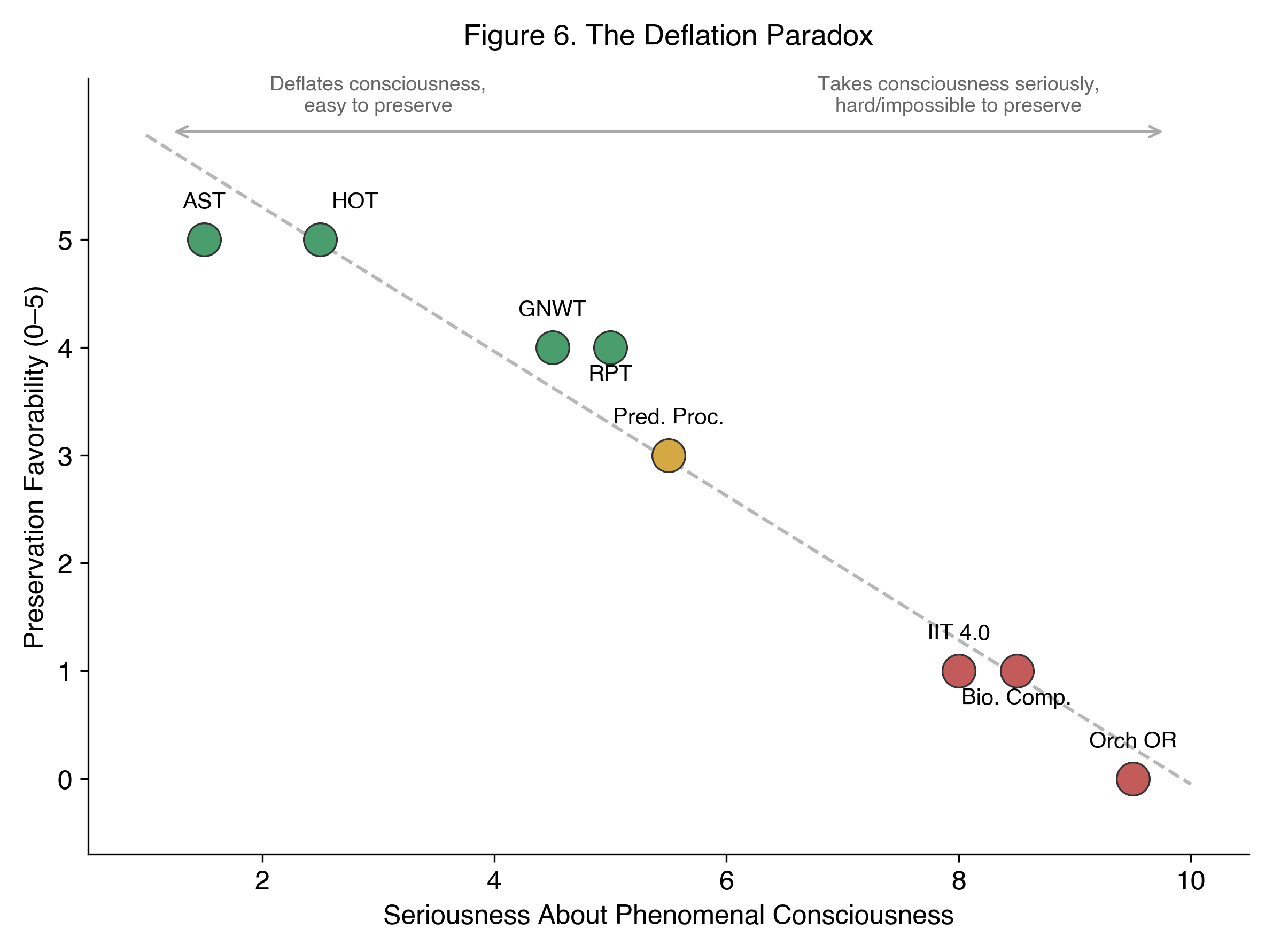
This is a real problem for anyone investing in preservation under the bet that their conscious experience is genuinely irreducible. The theories that support that intuition are the same theories that say preservation is impossible. If you are comfortable with the deflated view, where consciousness is a pattern, preservation is straightforward. But you must accept that what’s preserved is a pattern, not an essence.
I don’t try to resolve the paradox in the paper. I think it’s a real philosophical constraint, not just an artifact of how current theories are formulated. But noticing it changes how you read the rest of the engineering literature.
Strategy under uncertainty
I assess four preservation strategies against the full theory space.
| Strategy | # Theories Compatible | Near-term feasibility |
|---|---|---|
| Whole-brain emulation on digital hardware | 4 | High (2055–2080) |
| Gradual neuron-by-neuron replacement (silicon) | 5 | Low (~70+ years) |
| Biological preservation (cryonics + future revival) | 8 | Moderate (today, with practical risk) |
| Gradual replacement with bio-hybrid components | 7 | Very low (currently impossible) |
Cryonics-with-revival is the only strategy compatible with all eight theories, because a successfully revived biological brain satisfies every theory’s requirements by construction. The risk for cryonics is entirely practical (whether current preservation captures the relevant information; whether future revival technology will exist), not theoretical. Among non-cryonic options, gradual bio-hybrid replacement is the strongest cross-theory bet: 7 of 8 theories accept it. But it’s also the most technologically distant, requiring brain-wide single-neuron-resolution bidirectional BCI, which is roughly seven orders of magnitude beyond current state of the art on simultaneous neuron count. Even with aggressive doubling, the gap is decades.
Whole-brain emulation on digital hardware looks attractive on near-term feasibility but only works under 4 of 8 theories. If you’re betting on it, you’re betting on substrate independence. That bet should be conscious and explicit.
What this means in practice
The cleanest implication is the cost-effectiveness flip. Most consciousness-preservation funding right now goes to engineering: better scanning, more compute, denser BCIs. Under this analysis, those investments are conditional on which theory turns out to be correct. A 10-nm electron microscopy facility is wasted spend if AST is right (1 µm suffices). A 10^22 FLOPS supercomputer is wasted spend if Biological Computationalism is right (the computation has to be biological). The marginal dollar for someone who actually wants consciousness preserved goes further into consciousness theory experiments, particularly experiments that discriminate between substrate-independent and substrate-dependent theories, than into incremental engineering.
For cryonics organizations: keep going. Biological revival is the only strategy that works under every theory, so improvements in preservation quality (cryoprotectant damage, perfusion completeness) keep more doors open than equivalent investment in scanning resolution.
For connectomics (Google/Harvard, E11 Bio’s PRISM): the connectome is necessary under 6 of 8 theories. Continued investment is well-justified almost regardless of which theory wins.
For BCIs (Neuralink, Paradromics): the gap to gradual-replacement requirements is so large that BCI throughput is not on the critical path for consciousness preservation this century. It may be the most important long-term bottleneck. It is not the binding constraint today.
What I want to put up front
I do not assign probabilities to the eight theories. Some of them (GNWT, Predictive Processing) have substantially more empirical support than others (Orch OR, Biological Computationalism). A more useful follow-up than this paper would be a formal decision-theoretic analysis that weights theories by current empirical evidence and computes expected utility for each preservation strategy. I would like to see somebody do that. I haven’t.
I treat the theories as monolithic when in fact each has internal variants. Lau’s perceptual reality monitoring formulation of HOT differs from Rosenthal’s classical version in ways that affect preservation implications. There are versions of Predictive Processing that come down on either side of the substrate-independence question. I flag these where they bear directly on the conclusion.
I focus on information-theoretic and computational requirements. Cost is a separate issue I don’t address; a full human-brain connectome scan at the resolution GNWT requires could plausibly cost billions of dollars even if the technology exists, which may end up being the binding constraint regardless of which theory wins.
And I assume the eight current theories exhaust the possibility space. They almost certainly don’t. A future theory of consciousness may carry preservation implications none of these eight cover. That’s the limit of any survey: it captures the field’s current shape, not its eventual shape.
What I’d want to read next
Three things, in priority order.
A formal decision-theoretic version of this analysis that assigns probabilities to theories from current empirical evidence and computes expected utility per dollar across preservation strategies. This is the work that would actually inform funding decisions. It’s also work I am not the right person to lead.
An engineering-side analysis that maps each theory’s requirements to specific technology roadmaps (scanning, simulation, BCIs, biological replacement) and identifies the theory-conditional critical path for each strategy. Right now the engineering literature implicitly assumes one theory; that assumption needs to be decoupled.
A deeper philosophical analysis of the deflation paradox. I noticed it. I don’t know whether it represents a genuine constraint on what any future theory of consciousness could look like, or an artifact of how the current eight are formulated. Someone with more time in philosophy of mind than I have should look at it.
Notes on how this got written
This is the first paper in a planned trilogy. Paper 2 (10.5281/zenodo.19738204) is an exploratory transplant assay testing whether AST’s central data structure (the attention schema) actually transfers across substrate in a toy neural agent. Result was mixed-negative on a single seed: the data structure makes the trip, but the function it implements does not, under frozen direct transfer. That’s a much narrower, more concrete version of the engineering question this first paper tries to scope. Paper 3 is in draft and proposes a benchmark scaffold for testing preservation-relevant functional continuity across substrate transfer, turning the philosophical disagreement into something you can score.
I wrote this first paper because consciousness is the question I keep coming back to, and the engineering proceeds without reference to the theories in a way that struck me as a missing spec. It is the kind of paper an outsider can write because the inside of the field is busy arguing within theories rather than across them. The audit framing is what I know how to do; the neuroscience and philosophy I had to learn from the literature.
If you read one section, read the deflation paradox. The rest is engineering bookkeeping in service of that one observation.
Preprint: 10.5281/zenodo.19374628. Repository: Atomics-hub/consciousness-research. Paper 2, the AST transplant assay: 10.5281/zenodo.19738204. Paper 3, The Preservation Benchmark, is in draft at paper3/ in the same repo.
How this was written
This post was drafted from my notes by an AI model and then edited by me. The reasoning, decisions, and corrections are mine; the prose started from a machine. The underlying technical work this post describes is real.
Originally published at https://doi.org/10.5281/zenodo.19374628. Licensed CC-BY-4.0.