
The Weird Seriousness of Merch
TL;DR
I made Brick merch.
That sentence sounds funny to me. It has the slightly ridiculous energy of someone turning a personal philosophy into a little product table, which is exactly what happened.
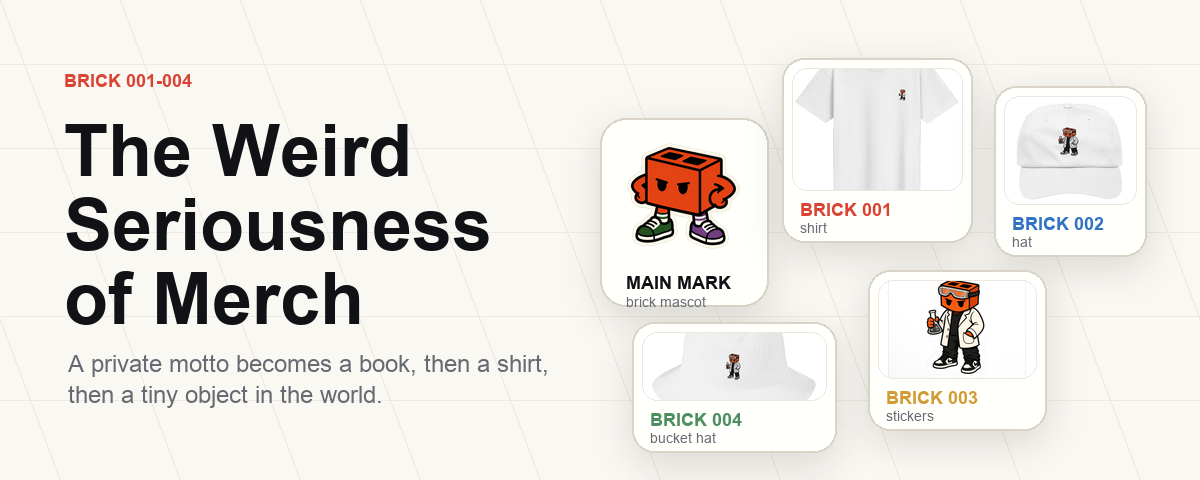
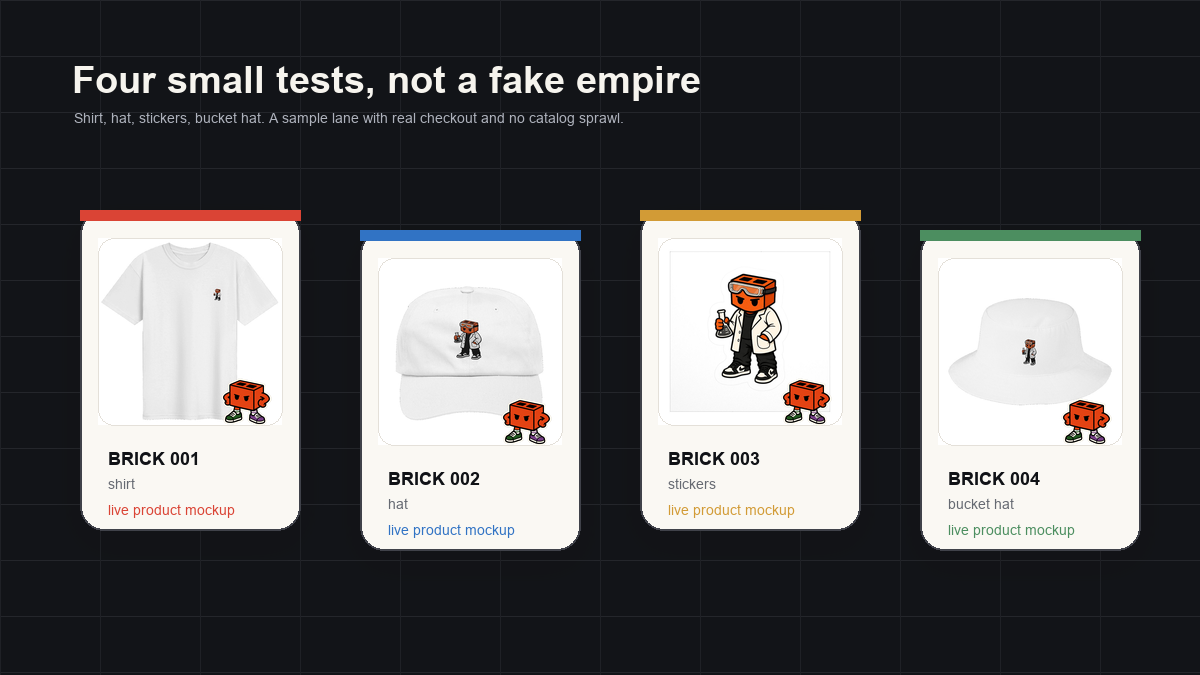
The Brick shop is live. Right now it is small on purpose: a shirt, a hat, stickers, and a bucket hat. Brick 001 through Brick 004. Original mascot only. No fake catalog sprawl. No attempt to pretend this is suddenly a giant apparel company.
But I also think there is something real in it.
Merch is easy to dismiss because the word has been flattened by the internet. It can mean a cash grab, a drop, a logo slapped on a blank, a creator trying to monetize a joke that stopped being funny three months ago.
That is not the version I care about.
The version I care about is stranger and more sincere:
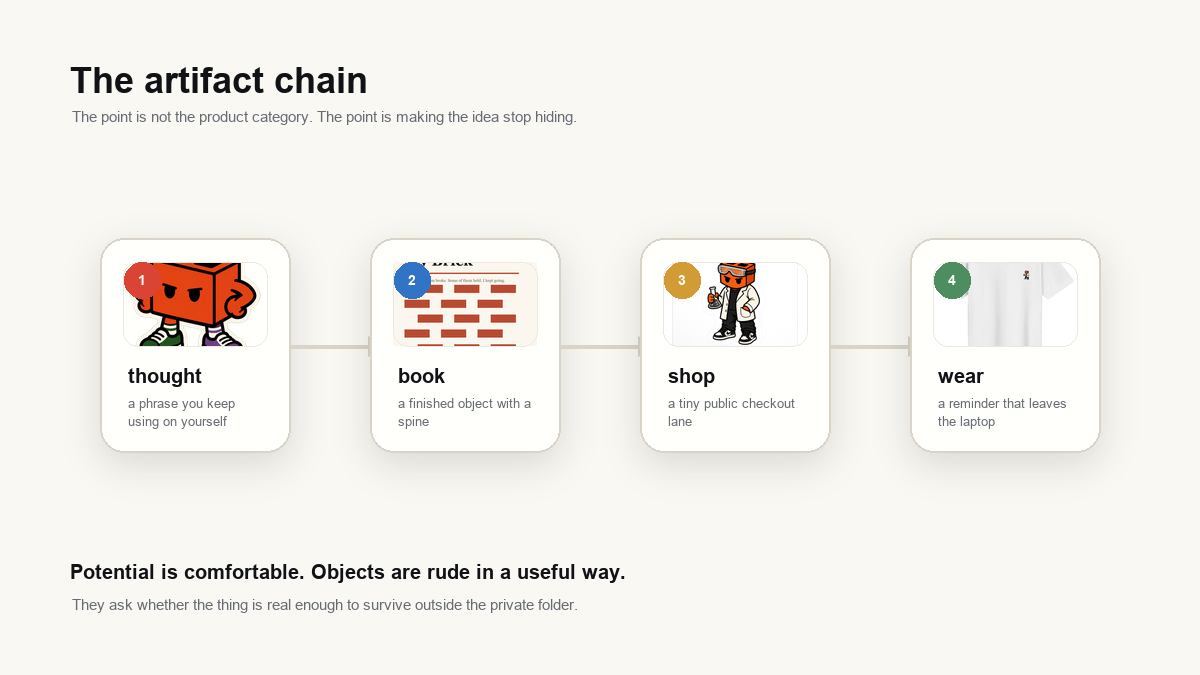
A phrase you keep using on yourself becomes an object that can exist without you explaining it.
That is the thing.
Brick by Brick started as a way to talk myself through drift. Then it became an essay shape. Then it became a book. Now there is a tiny shop where the same idea can become a shirt, a hat, or a sticker. Not because the world urgently needs another hat. It does not. Because sometimes an idea gets more honest when it has to leave the private folder and survive as an object.
Why merch feels dumb
Merch feels dumb because it sits right on the border between meaning and commerce.
If you make a paper, people know how to classify it. If you make an app, people know how to classify it. If you make a book, there is still some built-in seriousness around the object, even if the book itself is bad.
Merch does not get that benefit.
Merch is a hoodie. A shirt. A sticker. A hat. It is too close to the body and too close to money. It asks the embarrassing question directly: would anyone actually want to wear this?
That is a useful question.
Not because a shirt is the highest form of an idea. It is not. But because it removes a hiding place. A private motto can stay vague forever. A draft can stay protected by the fact that nobody has to react to it. A phrase in a note can feel profound because it never has to touch fabric, checkout, shipping, sizing, taste, or the stupid plain reality of whether it looks good on a hat.
Objects are rude in a useful way.
They do not care what you meant.
They just sit there.
The artifact chain
I keep coming back to the same loop:
- thought
- artifact
- proof
- next artifact
That sounds cleaner than it feels. The actual process is always more awkward. You have a phrase in your head. It means something to you, but maybe only to you. You say it enough times that it starts to feel load-bearing. Then the question becomes whether you are willing to turn it into something with edges.
For Brick by Brick, the first real edge was the book.
The book made the idea less slippery. It forced the phrase to carry chapters, a cover, a spine, an Amazon listing, and the quiet humiliation of being imperfect in public.
The merch is a different kind of edge.
A book asks whether the idea can be read.
Merch asks whether the idea can be carried.
That is a smaller question in one sense and a scarier one in another. Reading is private. Wearing is social. A sticker on a laptop, a shirt in a gym, a hat at a coffee shop, all of that changes the relationship. The phrase is no longer only something you think. It is something you let into the room with you.
What Brick means to me
Brick by Brick is not complicated.
It means: do the next real thing.
Not the most aesthetic thing. Not the thing that proves your life has finally snapped into a clean arc. Not the thing that lets you leap over the boring middle.
The next real thing.
Some bricks are impressive. Most are not.
The workout nobody sees. The draft that is still bad. The commit that only fixes one edge case. The song that does not blow up. The product page with four small items instead of a grand launch campaign. The quiet choice not to drift today.
That is the philosophy, if it deserves that word.
I have a real weakness for wanting the whole thing to feel bigger than it is. I want the artifact to arrive with some final-form energy. I want the work to imply a clean future. I want each finished thing to solve the part of me that keeps asking whether I am actually becoming who I think I am becoming.
It never does.
The artifact just becomes another brick.
That is annoying.
It is also probably the healthiest version of the whole thing.
The sample lane
The shop is deliberately small.
Brick 001 is the shirt.
Brick 002 is the hat.
Brick 003 is the sticker.
Brick 004 is the bucket hat.
That is enough for now.
There is a version of this that gets overbuilt immediately. Full catalog. Big launch language. A bunch of variants. Some fake urgency. A product grid trying to act like a brand before the idea has earned that kind of weight.
I do not want that.
The sample lane is the cleaner test. Put a few simple objects into the world. Make checkout real. Make the page honest. Let it be small. Let the next signal come from reality instead of from my ability to generate more assets.
That last sentence is mostly a note to myself.
AI tools make expansion cheap. Taste has to make restraint expensive.
Just because I can make twenty designs does not mean I should. Just because I can turn every phrase into a product does not mean the phrase deserves a product. The hard part is not production anymore. The hard part is knowing what should exist, and stopping before the original signal gets buried under optionality.
Tiny flags
The best version of merch is a tiny flag.
Not in a tribal, team-logo way exactly. More like a reminder you choose to keep near the surface.
A running shirt can remind you that you are a person who runs. A sticker can remind you what project you are actually building. A hat can be stupid and still make the day feel a little more like yours.
That sounds minor because it is minor.
Most useful things are minor.
I do not think a shirt changes your life. I do think the objects around you can slightly change the texture of your attention. They can remind you what you said mattered before the day got noisy.
That is what I like about the Brick mascot. It is not cool in a slick way. It is a little funny, a little stubborn, a little too sincere. That feels right. The whole point of Brick by Brick is not to become an untouchable marble statue of a person. It is to keep building while remaining obviously made of breakable parts.
Not a sales pitch
This is where a normal post would probably start acting like a product page.
I do not really want to do that.
If you want the thing, the shop exists. If you do not, that is fine. I am not writing this because I think the world has been waiting for my bucket hat.
I am writing it because the motion matters to me.
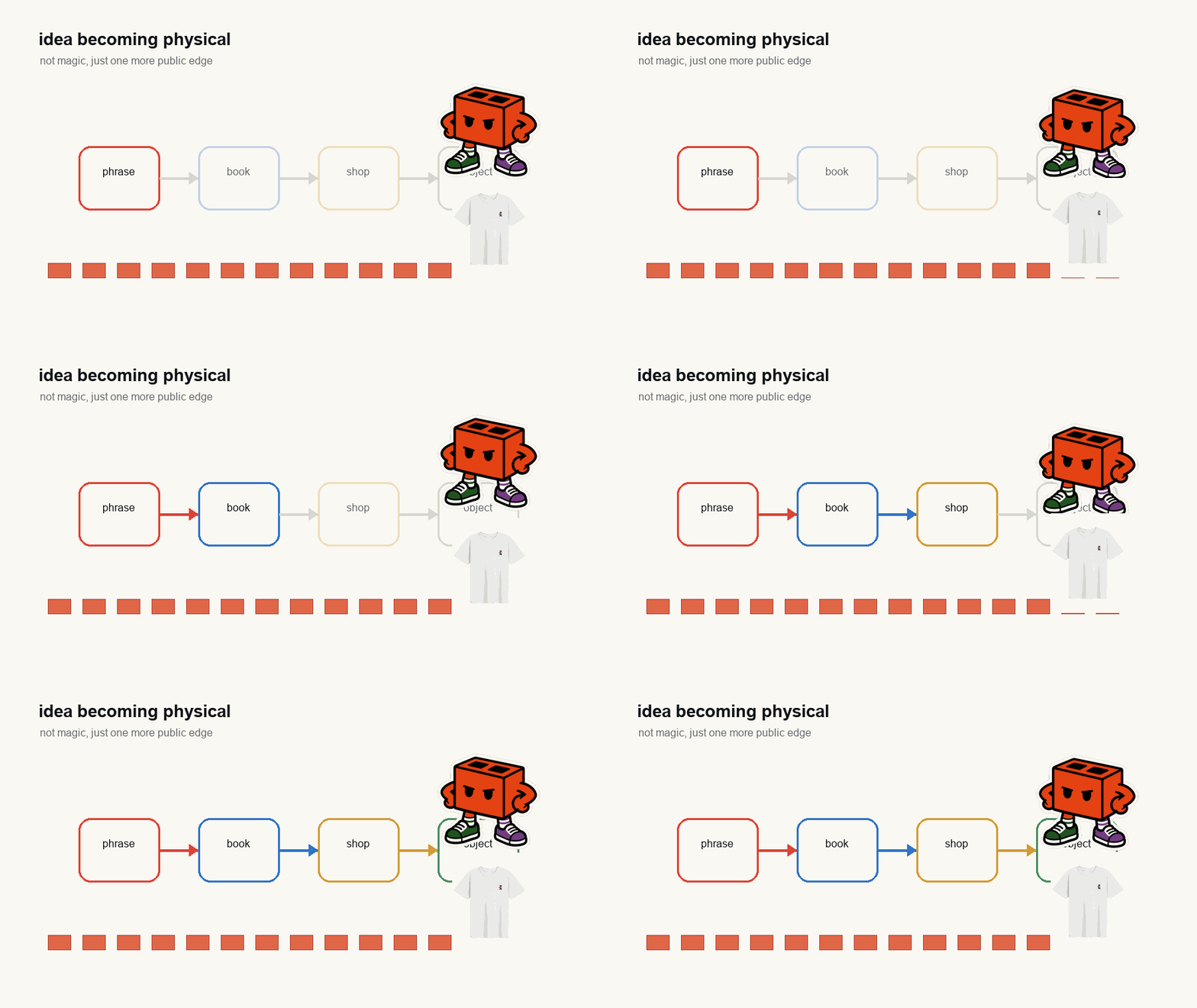
A private phrase became a book.
A book became a small shop.
A small shop became another proof point that the work can leave my head.
That is the thread.
It is the same thread running through the apps, papers, songs, security writeups, and whatever else I keep building. The categories change. The argument stays familiar:
Stop protecting the idea as potential.
Give it a shape.
Let it be judged by the world in the smallest honest way.
Then make the next thing.
The useful seriousness
So yes, merch is funny.
It is also serious, if you let it be serious in the right proportion.
Not serious like a grand business pivot. Not serious like a personality cult. Not serious like everyone should now dress in the uniform of my private self-improvement spiral.
Serious like this:
I had an idea that helped me.
I turned it into a book.
I turned the book’s center of gravity into a few physical objects.
Now the idea has one more way to exist.
That is enough.
The shop is live here: BRICK 001.
Some of the bricks broke.
Some of them held.
I kept going.
How this was written
This post was drafted from my notes by an AI model and then edited by me. The reasoning, decisions, and corrections are mine; the prose started from a machine. The underlying technical work this post describes is real.
Licensed CC-BY-4.0.