
Brick by Brick is live
TL;DR
I published a book.
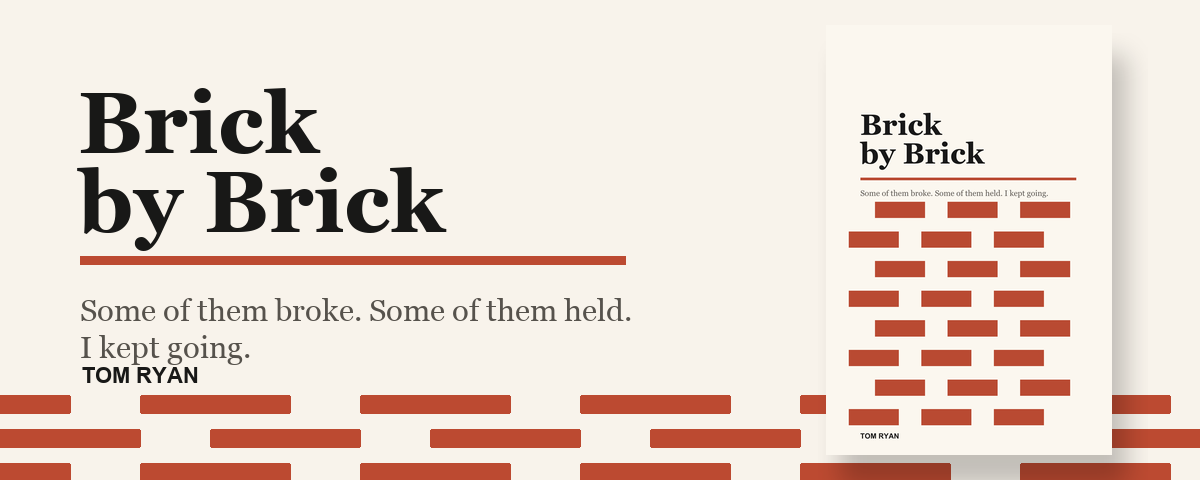
Brick by Brick is live on Amazon.
It is a short book about drift, proof, pressure, taste, tools, the body, and building a life one uneven brick at a time. It is not a success manual. It is not a clean victory lap. It is closer to a field note from the inside of a brain that wants too much, doubts itself constantly, and keeps trying anyway.
The subtitle on the cover says the thing plainly:
Some of them broke. Some of them held. I kept going.
That is the whole book, really.
The weirdness of publishing a book
Publishing a book is strange because it sounds bigger than it feels.
You imagine some movie version of it. You finish the last line, push away from the desk, stare out a window, and something inside you finally clicks into place. The artifact is done, so the person is done too. The pressure is resolved. The doubt shuts up. The neat little arc closes.
That is not what happened.
What happened is that I wrote a book, edited it, formatted it, made the cover, pushed it through the machine, and eventually there was a paperback listing on Amazon with my name on it. A real object. A thing somebody can buy, hold, throw on a desk, ignore, mark up, or maybe read on a weird night when they feel like they are trying to become someone and failing at it.
That is enough.
It has to be enough, because the trap is thinking every artifact has to solve you. The app has to solve you. The paper has to solve you. The job has to solve you. The book has to solve you.
It does not.
It just becomes another brick.
What the book is actually about
Brick by Brick is about trying to build a life without pretending the process is cleaner than it is.
There is a version of ambition that gets sold like a straight line. Pick the goal. Execute the plan. Win. The actual version, at least for me, has never looked like that.
The actual version is messier.
You build something and it works.
You build something else and nobody cares.
You get into a rhythm and then drift starts pulling at the edges.
You think you have taste, then you realize taste is not just liking good things. It is choosing what to ignore. It is letting a hundred interesting doors stay closed so one door can actually become a room.
You think tools will save you, then you realize tools mostly amplify the person holding them.
You train your body because the mind cannot be trusted to carry the whole load by itself.
You chase proof because the inside of your own head is too easy to negotiate with.
And somewhere in all that, you try to become less full of shit.
That is the book.
Not in a polished guru way. More like: here are the pieces I keep coming back to, here are the parts of me I keep fighting, here is the argument I am making with myself in public.
Why I wanted this to exist
I think a lot about artifacts.
A shipped app is different from an idea for an app. A paper with a DOI is different from notes in a folder. A song on streaming platforms is different from a loop sitting on a hard drive. A book on Amazon is different from a voice note about someday writing a book.
The outside world may not care much about the difference. But I do.
Because an artifact makes the claim harder to weasel out of. It says: I took this far enough that it can stand outside me now.
That does not make it good automatically. Plenty of shipped things are bad. Plenty of private things are brilliant. But finishing changes the shape of the thing. It stops being protected by potential.
Potential is a warm hiding place. You can live there forever if you are not careful.
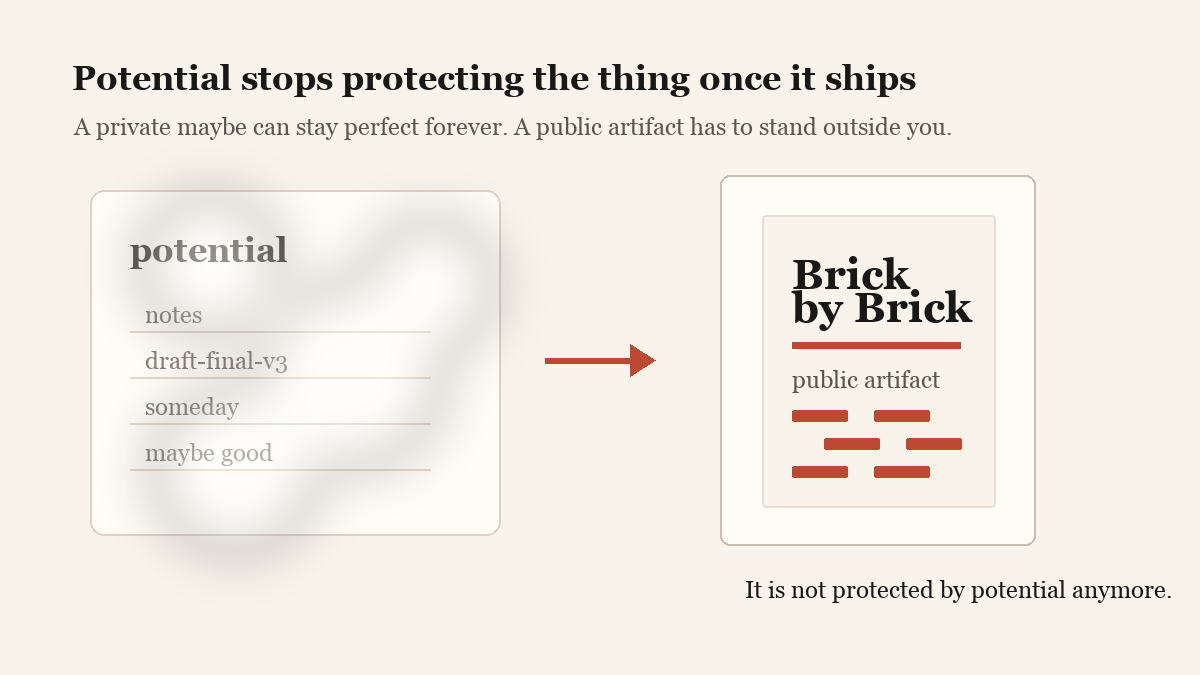
Brick by Brick is partly an attempt to leave that hiding place one more time.
I wanted a physical book because physical things have a different kind of disrespect for excuses. A paperback is not a folder named final-final-v3. It is not a private doc I can keep revising until the heat death of the universe. It is a little block of paper with a cover and a spine, and if it is imperfect, good. That was probably the point.
The body is in the book for a reason
One thing I did not want was a purely mental book.
There is a certain type of builder writing that treats the body like a laptop stand for the brain. I do not buy that anymore.
When my life is going well, my body is usually involved. Running, lifting, fighting, walking, sleeping, sweating, getting humbled by a workout I thought would be easy. All of it changes the texture of the day.
The body gives you a cleaner truth than the mind does.
The mind can rationalize anything. It can turn laziness into strategy, fear into patience, drift into optionality, and exhaustion into some noble story about how hard you are grinding.
The body is less impressed.
Did you run?
Did you sleep?
Did you eat like a person who wants the future he claims to want?
Did you do the work when nobody was watching?
The answers are usually simple. Not always easy, but simple.
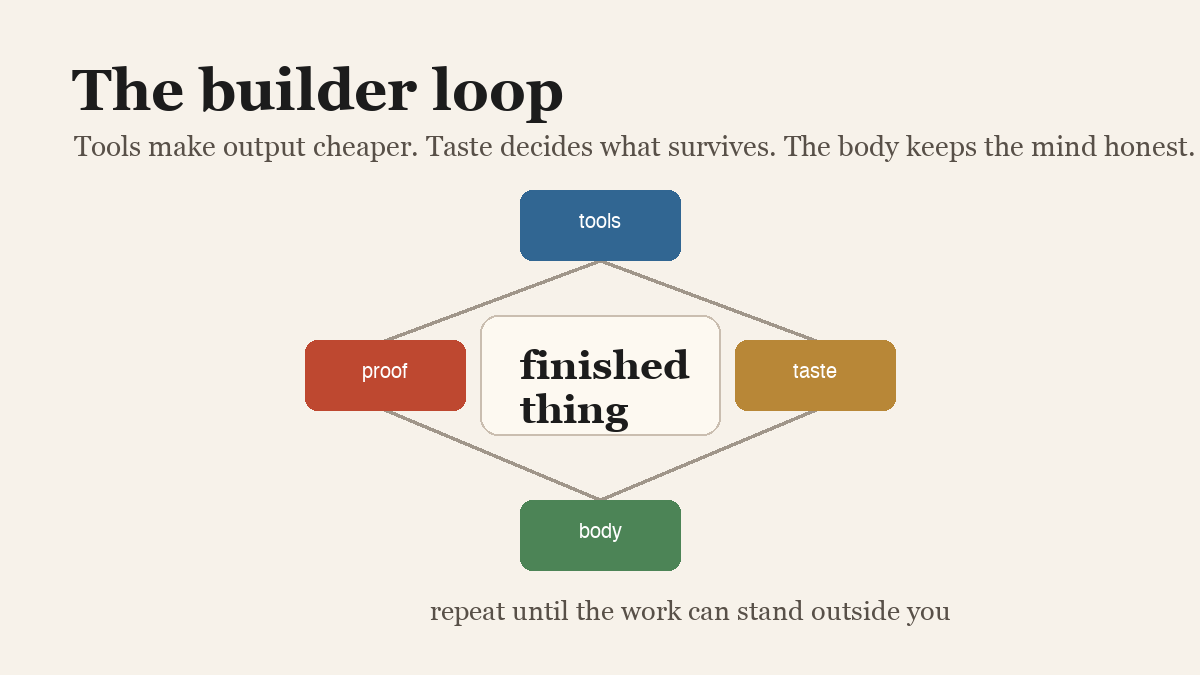
That is why the book keeps coming back to the body. Not because fitness is the whole game. Because physical proof is one of the best antidotes I know to the kind of mental fog ambition can produce.
Tools and taste
The other big thread is tools.
I live in a weird era where a lot of the things I want to do are suddenly more possible than they were a few years ago. I can use AI to help write, code, research, edit, test ideas, build apps, generate music, audit systems, and turn rough thoughts into something with edges.
That is insane.
It is also not enough.
The tool can give you output. It cannot give you taste.
Taste is deciding what is worth keeping. Taste is knowing when the draft sounds impressive but dishonest. Taste is knowing when the feature works but the app feels wrong. Taste is knowing when the idea is clever but not alive. Taste is knowing when you are using the tool to build something, and when you are using the tool to avoid choosing.
Brick by Brick is a book about that distinction too.
Because the future is probably going to give us more leverage than we know what to do with. More agents, more automation, more loops, more ways to turn a thought into an artifact. The bottleneck will not only be “can you make things?” A lot of people will be able to make things.
The bottleneck will be: do you know what should exist?
And once you know, can you stay with it long enough for the bricks to stack?
What finishing changed
I do not want to oversell the emotional ending.
I finished the book and did not become a new person. I did not suddenly feel satisfied forever. I did not wake up immune to drift or fear or comparison.
But something did change.
There is now a book in the world that did not exist before.
That matters.
It matters in the same way a run matters even if nobody sees it. It matters in the same way a commit matters even if nobody stars the repo. It matters in the same way a song matters before the algorithm decides whether to bless it.
The work is not only valuable when it becomes huge.
That is a hard thing for me to believe, but I think it is true.
If everything has to become massive before it counts, you end up disrespecting almost your entire life. Most days are not massive. Most bricks are not beautiful. Most work does not arrive with fireworks.
But the stack is real.
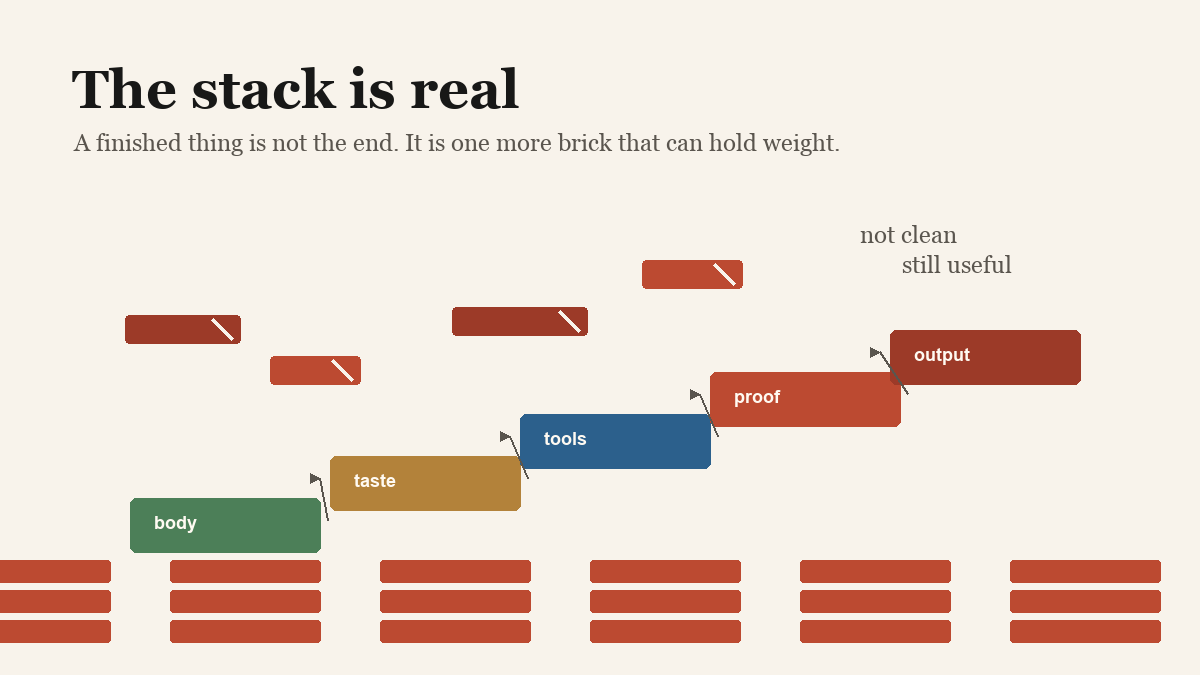
That is what I am trying to remember.
Read it
If you want the polished sales pitch, I do not really have one.
If you are building something, or trying to build yourself into someone, and you sometimes feel like the whole thing is more fragile and ridiculous than anyone admits, you might like the book.
If you are in a season where you are fighting drift, trying to develop taste, trying to use tools without being used by them, trying to keep your body and mind on the same team, you might like it too.
And if none of that applies, that is fine. I still wanted this object to exist.
Some of the bricks broke.
Some of them held.
I kept going.
Brick by Brick is live on Amazon.
How this was written
This post was drafted from my notes by an AI model and then edited by me. The reasoning, decisions, and corrections are mine; the prose started from a machine. The underlying technical work this post describes is real.
Licensed CC-BY-4.0.